.png)
Why MLD is Essential for Facial Cosmetic Surgery: The Science of Manual Lymphatic Drainage in Aesthetic Rehabilitation

The Hidden Key to Aesthetic Recovery: Why Precision in Lymphatic Drainage Matters

For many people, the journey toward their aesthetic goals doesn't end when they leave the operating room; it truly begins during the recovery phase.
While postoperative swelling is a nearly universal experience after aesthetic surgery, the way we manage that fluid can dictate the speed of healing and the quality of the final result.
Central to this management is Manual Lymphatic Drainage (MLD), a specialised technique considered the gold standard in lymphatic therapy (1-4).
As research into the utility of MLD grows, it is becoming clear that efficacy is inextricably linked to the precision of application inherent in the original Vodder techniques, and the quality of the therapist's training.
The Rare Risk: From Transient Oedema to Lymphoedema
Most people undergoing cosmetic surgery can expect a degree of "normal" swelling that peaks in the days following surgery and resolves within a few months (1). However, a previously intact lymphatic system can occasionally be damaged during aesthetic procedures, leading to secondary lymphoedema. While rare, this chronic condition is characterised by the accumulation of protein-rich fluid, inflammation, and even tissue deposition (2).
Studies have documented that persistent oedema—swelling that lasts beyond the typical six-week healing window—may indicate early lymphatic compromise (1). For instance, one study following liposuction patients found that 1.7% developed significant persistent oedema, while another cohort undergoing thighplasty reported a lymphoedema incidence of 8.2% (1). Risk factors such as extensive liposuction, large-scale body contouring, and vertical incision techniques that traverse critical lymphatic trunks, require careful postoperative monitoring (1).
Translating Lymphoedema Therapy to Cosmetic Rehabilitation
The clinical world has long valued the core role of MLD in Complete Decongestive Therapy (CDT) for treating chronic lymphedema (1,2). Today, surgeons and therapists are successfully translating these concepts to the cosmetic context to deliver the benefits of MLD in skin rehabilitation.
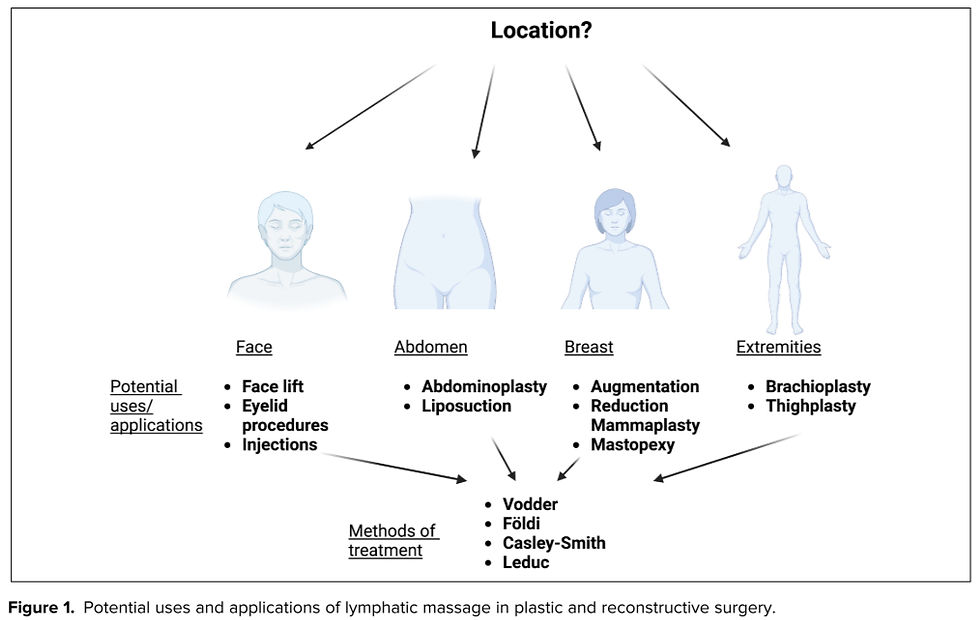
In aesthetic "rehab," MLD serves to prevent fibrosis (skin hardening), and reestablish lymph pathways toward functioning channels, and minimise scar formation (2).
MLD improves capillary perfusion without adding to the oedema, simultaneously reducing excess tissue fluids. This reduces pain and facilitates tissue healing (2).
This is particularly beneficial in procedures like abdominoplasty, where the primary drainage route may shift from the groin to the armpit following surgery (2). MLD supports the lymphatic system during the critical first 6-month window of recovery, and the mechanical workout applied to the connective tissue fibres during the remodelling phase helps to resolve the "lumps and bumps" that can otherwise compromise aesthetic outcomes (2).
The Gap in Facial Plastic Surgery Research
Despite its frequent use for body contouring, specific clinical trials regarding the effects of MLD after facial plastic surgery remain relatively rare (2).

However, the studies that do exist offer compelling evidence for its benefits. Research focused on eyelid and nose surgeries demonstrated that patients receiving MLD experienced a significantly faster reduction in edema compared to those who did not (3).

Beyond physical swelling, MLD has been shown to provide significant psychological benefits.
One study measured salivary cortisol—a primary stress hormone—and found that MLD significantly lowered stress levels in patients recovering from facial procedures (4).
By calming the autonomic nervous system and promoting a shift toward a "rest and digest" state, MLD helps anxious patients achieve the mental and physical relaxation necessary for optimal healing (3).
MLD: The Gold Standard in Beauty Therapy

While clinical trials catch up, beauty therapists have successfully used MLD for decades to manage skin conditions such as acne, rosacea, and sensitive skin (4).
Even without the trauma of surgery, slow flowing lymph can lead to the accumulation of cellular waste and toxins. MLD encourages the removal of these metabolic by-products, improving skin nutrition and accelerating the regeneration of tissues.
Whether it is reducing the appearance of old scars or calming an inflammatory flare-up, MLD remains the preferred non-invasive tool for skin health (4).
The Necessity of Precision: The Vodder Method
The effectiveness of MLD is not a result of simple massage; it is a highly technical discipline governed by three strict principles: pressure, direction, and tempo.

Research has highlighted that the quality of training is paramount. For example, a study on facial MLD found that a tempo of approximately 30 cycles per 60 seconds (one cycle every two seconds) was the most effective for reducing edema (4).
Direction is perhaps the most critical factor. MLD applies precise bi-directional stretch and shearing forces into the tissue with respect to the lymph pathways and the functional range of the connective tissue fibres. This increases lymph flow and reduces tissue congestion.
This level of precision leads to a clear conclusion: for safety and efficacy in a post-surgical context, it is essential to study and apply the original Dr. Vodder method (4). Developed in the 1930s, the specialised hand movements—such as the "stationary circle"—are designed specifically to move fluid across anastomoses (pathway connections) from impaired regions to healthy ones (2). Only through the rigorous training associated with the original Vodder technique can a therapist ensure they are supporting, rather than hindering, the delicate lymphatic system during the recovery journey.
Find out more in our FREE #TLL Interactive Webinar
Tuesday May 26, 2026
Register for Auckland: Basic Neck & Face / Advanced Neck & Face
August 24 - 28, 2026 (4.5 -days)
References
Phondge, V., et al., Beyond Swelling: A Review of Postoperative Lymphedema in Aesthetic Surgery. Lymphatics, 2025. 3(3): p. 26.
Marxen, T., et al., The Utility of Lymphatic Massage in Cosmetic Procedures. Aesthetic Surgery Journal Open Forum, 2023. 5.
Min, J.-Y. and H.-J. Kim, The Effect of Manual Lymph Drainage on the Reduction of Stress and Edema after Facial Aesthetic Plastic Surgery. Kor J Aesthet Cosmetol, 2010. 8(4): p. 0-0.
Han, Y.-S., A Study of the effect on facial treatment according to direction and tempo of the MLD(manual lymph drainage) stationary circles technique. Kor J Aesthet Cosmetol, 2005. 3(1): p. 119-124.


Comments